Nature never ceases to amaze—with its colors, shapes, and fragrances.
Vitosha Mountain, stretching 19 km in length and 17 km in width, is the oldest nature park in the Balkans. This volcanic massif lies just outside Sofia, the capital of Bulgaria, and is one of the city’s most iconic landmarks. With its year-round appeal, Vitosha is ideal for hiking, climbing, skiing, or simply enjoying a walk in nature.
The mountain resembles a giant dome, the result of ancient volcanic activity and the gradual folding and uplifting of granite rock layers over millennia. Its highest peak, Cherni Vrah (Black Peak), stands at 2,290 meters and is one of ten Vitosha summits rising above 2,000 meters.
The name “Vitosha” is believed to come from the mountain’s distinctive twin-peaked ridge, which has gradually taken its current shape through natural processes over thousands of years.
One Sunday morning, inspired by photos of unusual pink cones, we decided to go searching for them ourselves.
We drove up to Aleko, the main tourist and sports center on Vitosha, and from there hiked to Fizkulturnik Hut.
Aleko, located at 1,820 meters, offers accommodation at the Aleko Chalet, along with several hotels, ski runs, lifts, restaurants, cafés, and ski/snowboard schools. It’s accessible via a 6.27 km gondola lift from the Simeonovo district of Sofia, or by road from Dragalevtsi. Aleko is also a hub for several hiking trails.
From Aleko, we followed the trail to Fizkulturnik Hut. According to my Fitbit, the route is about 7 km. As someone who isn’t a frequent hiker, I can confirm it’s an easy walk with stunning views, and it took us just under an hour and a half at a leisurely pace.
Fizkulturnik Hut is nestled near Golyam Kupen Peak, offering spectacular panoramic views of Vitosha’s slopes below and above, as well as distant vistas of the Rila Mountains to the south and Plana Mountain to the east. It’s a breathtaking route that I’d recommend to anyone.
And yes—on our way there, we did spot the pink cones.
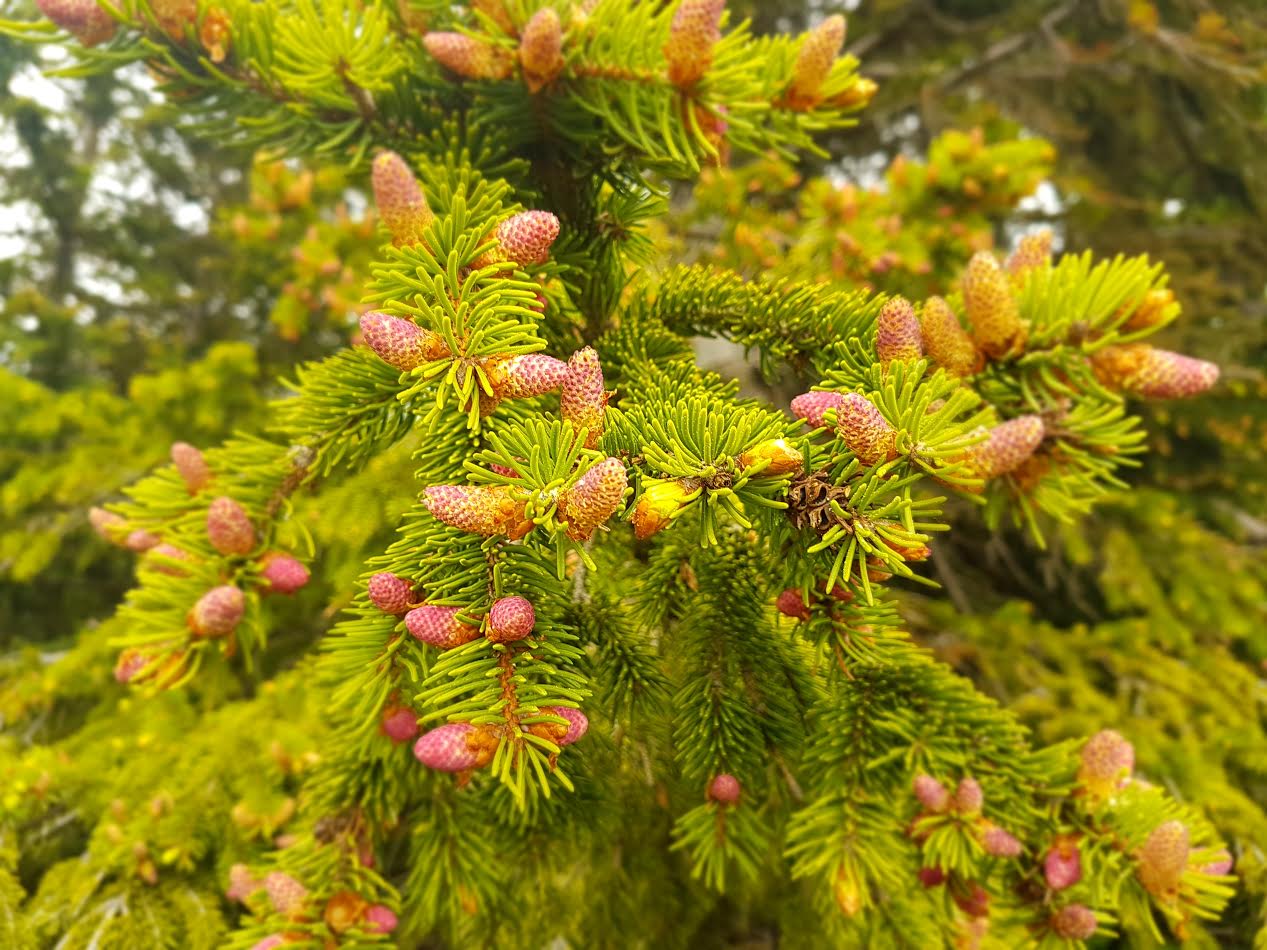
The term “cone” comes from their resemblance in shape to geometric cones. These structures, composed of individual plates called scales, are typical of conifer trees.
What we saw were immature male cones—also known as pollen cones or microstrobili. These are relatively consistent in structure across conifer species, differing only in minor ways like the arrangement of scales. The pink ones, in particular, are visually striking and an unexpected joy to find on a mountain walk.
We captured our day in a short 60-second video. The music I chose for the background is from the song “You Are Beautiful, My Forest”—a lyrical poem by Bulgarian writer Lyuben Karavelov, composed by Georgi Goranov. Written during Karavelov’s exile, the poem expresses deep nostalgia for his homeland’s natural beauty. The song is widely regarded as the unofficial anthem of Koprivshtitsa and the National Council of Bulgarian Folk Art.
 Ray Marketing Comms
Get in Touch!